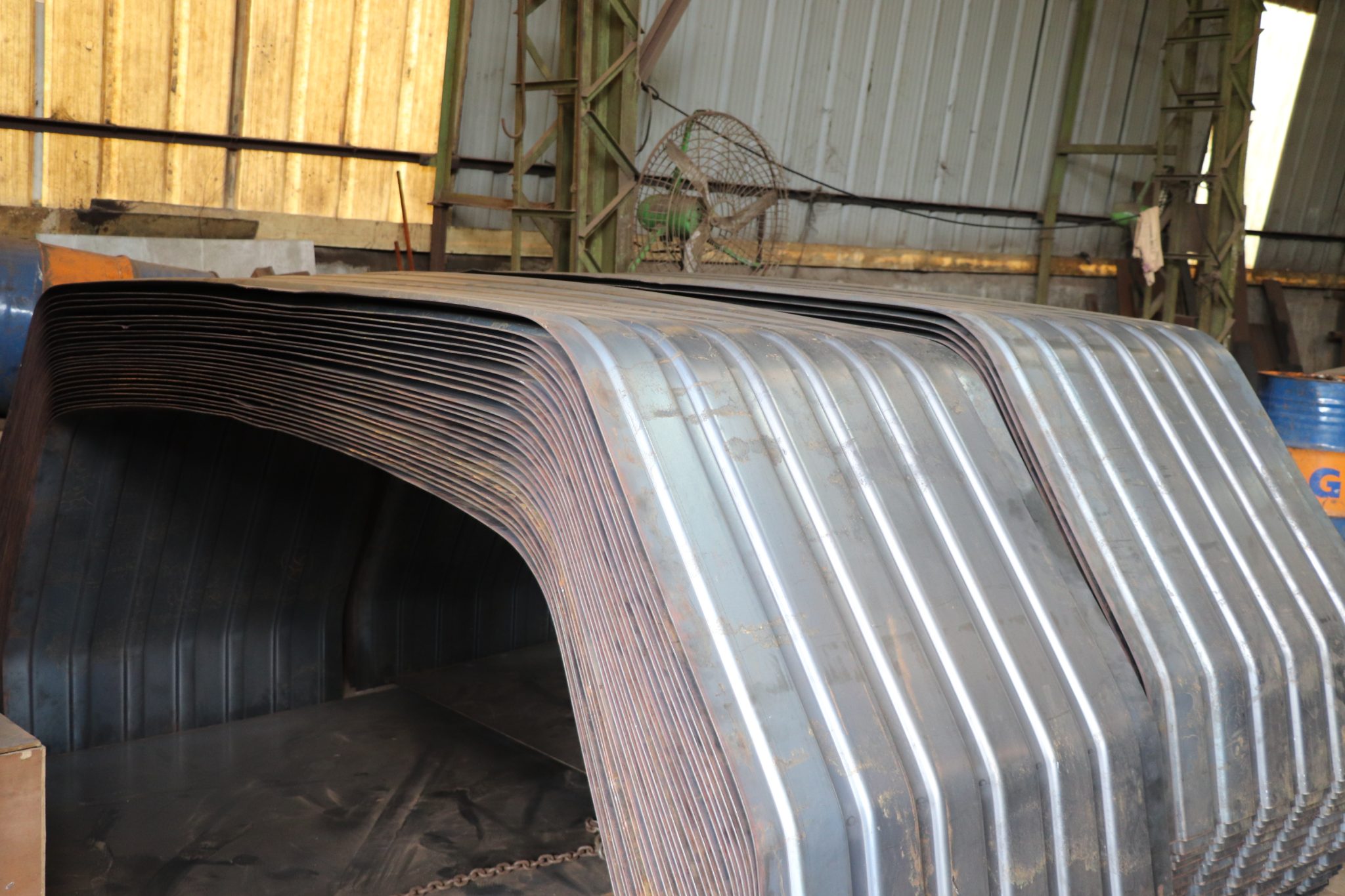
However, sometimes industrial or architectural applications demand far more complex geometry: a continuous spiral or helix. Spiral bending In Gujarat (also “helical bending”) refers to shaping metal into a spiral a coil-like, three-dimensional curved form. This can be used for curved stair railings, spiral stair stringers, curved conveyors or screw conveyors, helical structural supports, decorative metalwork, curved handrails, or other special-shaped metal components.
Spiral bending in Gujarat is more challenging than simple bending because:
- The curvature is continuously changing gradually over length rather than a single fixed bend.
- Depending on the section (pipe, tube, bar, flat, or channel), controlling deformation (thinning, distortion) is harder.
- Precise control over bending radius, pitch, and number of turns is often needed, especially for functional or aesthetic uses.
Thus, spiral bending In Gujarat, it usually demands specialised equipment or bending machines capable of multi-axis deformation, or custom fixtures, rolling, or bending-mandrel setups.
Why Kirti Engineering Could Potentially Handle Spiral Bending
Although their website does not explicitly mention “spiral bending”, several aspects of Kirti Engineering’s publicly listed capabilities suggest that they may be equipped to handle or adapt for complex spiral bending. Here’s a look at relevant signals from their site.
Kirti Offers “Bending Operation” and “Bending Machinery”
On their home page’s navigation bar, Kirti lists “Bending Machinery” and “Bending Operation” among their categories. ENGINEERING EQUIPMENT
Also, under their “Gallery” section, alongside images for cutting, shearing, screw conveyors, etc., there is a “Bending Operation” category. ENGINEERING EQUIPMENT
This indicates that Kirti does custom or industrial bending work, which is more than just straight cuts or simple bends.
They Do “Screw Conveyor Bending Process”
A concrete example: they explicitly offer a “Screw Conveyor Bending Process” for manufacturing screw conveyors that may need bending/shaping to fit layout constraints. (ENGINEERING EQUIPMENT)
Screw conveyors often require curved or helically bent flights or troughs to maintain throughput and proper alignment, which implies they have experience in bending metal sections in non-trivial geometry.
Strong Fabrication Infrastructure & Customization Mindset
Kirti emphasises “customised solutions for every industry” and “tailor-made equipment and configurations” rather than a “one-size-fits-all” approach. (ENGINEERING EQUIPMENT)
They also seem to serve fabrications such as railings, enclosures, ducts, sheds, partitions, etc. (per external listing). (Justdial)
Given these, it’s plausible that if a client approaches them with a spiral bending requirement (pipe, tube, flat bar, railing, curved conveyor, etc.), they may be willing to design and manufacture accordingly.
What Spiral Bending with Kirti Engineering Might Look Like: Potential Use-Cases & Approach
If you were to request spiral bending from Kirti Engineering, here’s how their existing capabilities might be leveraged and what kind of deliverables you could expect.
Possible Use-Cases
- Curved/Screw conveyors: If you need a screw conveyor that curves or loops, maybe to fit a compact layout in a plant, Kirti’s “screw conveyor bending process” suggests they could fabricate curved sections or custom trajectories.
- Curved railings/staircases/handrails: For architectural or industrial installations curved metal railings, spiral stair stringers, or protective guardrails – their bending capability and fabrication infrastructure may be adapted to form smooth curved shapes.
- Custom curved structural/sheet-metal components: In sheet-metal or structural-metal jobs requiring complex curves (cylindrical shells, curved ducts or housings, curved frames), Kirti’s bending + cutting + welding + blower-housing/casing work could combine to deliver bespoke curved parts (e.g., curved blower housings, ductwork).
- Speciality conveyors or auger-type equipment: For materials handling, where conveyors need bends or helices (e.g., screw conveyors, auger-drive conveyors), Kirti’s welding, bending and fabrication expertise could serve well.
What the Process Might Involve
If you approach Kirti for spiral bending In Gujarat, likely steps would be:
- Specification & Drawing Submission: You provide the required shape, material type (pipe, tube, flat bar, sheet), cross-section, curvature (radius, number of turns), pitch (for helices), total length, welding/joint requirements, surface finish, load/usage requirements (if structural).
- Feasibility & Tooling Evaluation: Using their bending machinery, bending operation capabilities, and fabrication shop, Kirti would assess whether the requested curvature and material are feasible — possibly via sample/test bending or custom jig/fixture design.
- Fabrication & Quality Check: Bending (or rolling) + welding or joining (if sections need splice) + finishing (grinding, painting, surface treatment) + quality inspection (dimensional tolerance, curvature consistency, structural integrity).
- Delivery & Installation (if required) Since Kirti claims to serve clients across Gujarat and beyond with “on-time delivery” and “customer-first approach,” they could coordinate transport/installation if needed. (ENGINEERING EQUIPMENTS)
Why Spiral Bending Is Beneficial (and When to Use It)
Using spiral/helical bending instead of multiple straight segments welded together offers several advantages:
- Smooth continuous curves: A true spiral provides a smooth continuous curve rather than segmented joints aesthetic and functional benefit, e.g. in stair railings or conveyors for smooth material flow.
- Structural integrity: Fewer joints/welds reduces weak spots, improves strength and longevity (if bending is done properly).
- Efficient space usage: For layouts needing compact design e.g. conveyors in factories, spiral staircases a spiral uses space vertically or horizontally more efficiently.
- Versatility: With proper design and fabrication capability, you can produce curved elements from various raw materials (pipes, bars, channels, sheets), widening design flexibility.
- Customization: Ability to bend to custom radius/shape allows client-specific solutions rather than off-the-shelf.
These advantages align well with Kirti’s philosophy of “customized solutions” and “tailor-made configurations.” (ENGINEERING EQUIPMENTS)
Potential Limitations & What You Should Clarify When Ordering Spiral Bending
Of course, spiral bending In Gujarat especially custom, heavy-metal, or large components — is not trivial. Some aspects to consider / clarify:
- Material suitability: Not all metals or cross-sections bend smoothly into spirals. Tubes or pipes may deform (ovalization), sheets may warp, flat bars may twist. The feasibility depends on material type, thickness, ductility, cross-section, etc.
- Precision requirements: For architectural or conveyor use, the radius, pitch, and uniformity of the spiral must be precise. Expect detailed drawings and possibly sample/prototype before full fabrication.
- Need for specialised tooling/fixtures: Straight bending machines may not suffice — for tight helices, custom jigs, mandrels or roller sets may be needed.
- Cost and lead time: Custom geometry, testing, adjustments, and finishing all add to cost and time compared to standard straight parts.
- Transport and installation challenges: Spirals may be bulky or fragile; handling, shipping, and installation need careful planning.
Therefore, when you communicate with Kirti Engineering (or any fabricator), provide full specs and expectations, and ensure clarity on tolerances, finish, and delivery.
FAQ
Q1. What kind of bending operations does Kirti Engineering support?
A: On their website, Kirti lists “Bending Machinery” and “Bending Operation” as core capabilities, indicating they work with bends beyond just cutting or shearing. ENGINEERING EQUIPMENT
Q2. Does Kirti Engineering do custom metal fabrication, or just standard products?
A: Yes, they emphasise “customised solutions for every industry” and “tailor-made equipment and configurations”. ENGINEERING EQUIPMENT
Q3. If I need a spiral or curved metal structure, how should I communicate my requirements to them?
A: Provide detailed drawings or sketches showing material type, cross-section dimensions, desired spiral radius of turns or curvature geometry, any welding or finishing requirements, and where and how the part will be used.