Table of Contents
| Sr. No. | Topics |
|---|---|
| 1 | Introduction |
| 2 | What Are Industrial Blowers? |
| 3 | Key Features of Powerful Industrial Blowers |
| 4 | Types of Industrial Blowers |
| 5 | Benefits of Industrial Blowers |
| 6 | Applications of Industrial Blowers |
| 7 | How to Choose the Right Industrial Blower |
| 8 | Maintenance Best Practices |
| 9 | Frequently Asked Questions (FAQs) |
| 10 | Conclusion |
Introduction
Efficient air movement is a critical requirement in modern industrial operations. From ventilation and cooling systems to dust collection and pneumatic conveying, industrial blowers play a vital role in maintaining productivity, safety, and process efficiency.
Kirti Engineering Equipments offers powerful industrial blower solutions designed for continuous operation in demanding industrial environments. Our blowers are engineered to deliver high airflow, reliable pressure, energy efficiency, and long service life for industries across Vadodara, Gujarat, and India.
Key Features
- High airflow capacity
- Robust industrial construction
- Energy-efficient operation
- Low-maintenance design
- Reliable continuous performance
- Customizable blower solutions
- Suitable for heavy-duty industrial applications
What Are Industrial Blowers?
Understanding Industrial Blowers
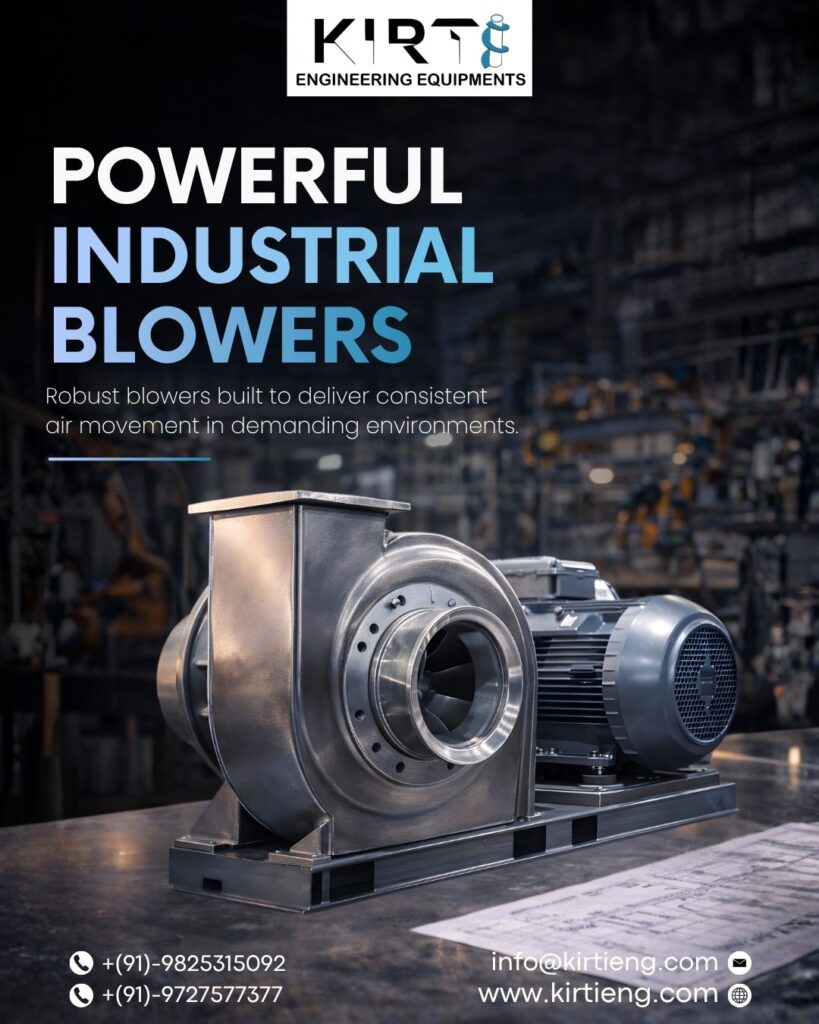
Industrial blowers are mechanical devices designed to move air or gases through a system by increasing airflow velocity and pressure. They are widely used in industrial processes that require controlled air movement.
Why Industrial Blowers Are Important
Industrial blowers support ventilation, drying, cooling, combustion air supply, dust collection, and material handling operations. Proper airflow systems improve process efficiency and workplace safety.
How Industrial Blowers Work
Blowers use rotating impellers to accelerate air and direct it through a housing system, generating the required pressure and airflow for specific industrial applications.
Key Features of Powerful Industrial Blowers
High Airflow Capacity
Designed to move large volumes of air efficiently for optimal industrial performance.
Robust Construction
Manufactured using high-quality materials to withstand harsh operating conditions.
Energy Efficiency
Advanced blower designs maximize airflow while minimizing power consumption.
Low Maintenance Design
Reduced wear and tear leads to lower maintenance costs and longer service life.
Reliable Performance
Consistent airflow and pressure ensure uninterrupted industrial operations.
Customizable Solutions
Blowers can be customized according to airflow, pressure, temperature, and process requirements.
Types of Industrial Blowers
Centrifugal Blowers
Used in ventilation, dust collection, and process air systems.
High-Pressure Blowers
Designed for applications requiring higher air pressure.
Medium-Pressure Blowers
Provide balanced airflow and pressure for general industrial processes.
Axial Flow Blowers
Commonly used for cooling and ventilation applications.
Customized Industrial Blowers
Engineered to meet unique operational and process requirements.
Benefits of Industrial Blowers
- Improved operational efficiency
- Reduced energy consumption
- Enhanced workplace safety
- Increased equipment lifespan
- Lower maintenance costs
- Reliable airflow management
- Better process control
Applications of Industrial Blowers
| Industry | Application |
|---|---|
| Manufacturing | Ventilation and material handling |
| Power Generation | Combustion air and cooling |
| Cement | Kiln operations and dust collection |
| Chemical Processing | Gas handling and ventilation |
| Food Processing | Drying and cooling systems |
| Wastewater Treatment | Aeration processes |
| Pharmaceutical | Clean air circulation |
How to Choose the Right Industrial Blower
- Determine airflow requirements
- Evaluate pressure requirements
- Check energy efficiency ratings
- Assess operating environment conditions
- Select a reliable manufacturer with technical support
Maintenance Best Practices
- Conduct regular inspections
- Clean blower components periodically
- Monitor airflow and pressure parameters
- Replace worn parts promptly
- Follow manufacturer maintenance guidelines
Why Choose Kirti Engineering Equipment?
Kirti Engineering Equipments is a trusted manufacturer of industrial blowers in Vadodara, Gujarat, and India. We combine engineering expertise with advanced manufacturing technology to deliver high-performance blower solutions.
Our advantages include:
- Custom blower design and manufacturing
- High-quality industrial-grade materials
- Energy-efficient blower systems
- Experienced technical team
- Competitive pricing
- Timely delivery across India
- Reliable after-sales support
Frequently Asked Questions (FAQs)
What is an industrial blower?
An industrial blower is a mechanical device used to move air or gases for ventilation, cooling, dust collection, and various industrial processes.
What industries use industrial blowers?
Manufacturing, power generation, cement, chemical processing, food processing, pharmaceutical, and wastewater treatment industries commonly use industrial blowers.
What are the benefits of industrial blowers?
Industrial blowers improve airflow, enhance productivity, reduce energy consumption, support ventilation, and ensure process efficiency.
How do I choose the right industrial blower?
Consider airflow requirements, pressure levels, operating conditions, energy efficiency, and application-specific needs.
Why is maintenance important for industrial blowers?
Regular maintenance improves reliability, extends equipment lifespan, reduces downtime, and ensures efficient performance.
Conclusion
Powerful industrial blowers are essential components in modern industrial operations. Their ability to provide reliable air movement, efficient ventilation, and consistent performance makes them valuable across numerous industries.
Whether used in manufacturing plants, power stations, chemical facilities, or wastewater treatment systems, industrial blowers help maintain productivity, safety, and operational efficiency.
By selecting the right blower system and implementing proper maintenance practices, businesses can maximize performance, reduce operating costs, and ensure long-term reliability.