Table of Contents
- Introduction to Advanced Bending Machinery
- What is Metal Bending Machinery?
- How Advanced Bending Machines Work
- Key Features of Advanced Bending Machinery
- Benefits of Precision Metal Bending
- Materials Suitable for Bending
- Applications of Advanced Bending Machinery
- Bending Capacity Up to 30 mm Thickness
- Advanced Bending vs Traditional Bending Methods
- Technical Specifications Table
- Why Choose Professional Metal Bending Services?
- Frequently Asked Questions
- Conclusion
Introduction to Advanced Bending Machinery
Metal bending is one of the most important fabrication processes used to shape sheet metal into desired forms and structures. Advanced bending machinery utilizes modern hydraulic, mechanical, and CNC technologies to ensure precise bends while maintaining material strength and dimensional accuracy.
Kirti Engineering Equipments is a trusted name in the metal fabrication industry, delivering high-quality engineering and fabrication solutions with a strong focus on precision, innovation, and customer satisfaction. Equipped with advanced laser cutting technology and modern bending machinery capable of handling metal sheets up to 30 mm thickness, the company provides reliable fabrication services for various industrial applications.
These machines are capable of handling simple bends, complex geometries, and heavy-duty industrial requirements, making them indispensable in today’s manufacturing sector.
What is Metal Bending Machinery?
Metal bending machinery is specialized equipment used to deform metal sheets and plates into specific angles and shapes without cutting or removing material.
Advanced bending machines use controlled force to create precise bends while minimizing defects such as cracking, distortion, or uneven angles. CNC-controlled systems ensure repeatable and highly accurate results for large production volumes.
How Advanced Bending Machines Work
Design and Programming
The required dimensions and bending specifications are created using CAD software and programmed into the CNC control system.
Material Positioning
Metal sheets are accurately positioned within the machine using back gauges and positioning systems.
Precision Bending Process
The punch applies force against the die to bend the metal according to programmed specifications.
Quality Inspection
Finished components are checked for angle accuracy, dimensions, and overall quality.
Final Production
The completed parts are prepared for assembly, welding, coating, or further fabrication processes.
Key Features of Advanced Bending Machinery
High Precision Bending
Delivers accurate bends with tight tolerances for industrial applications.
Bending Capacity up to 30 mm Thickness
Capable of processing thick metal sheets for heavy-duty fabrication projects.
CNC Control System
Automated programming ensures consistency and repeatability.
Smooth Surface Finish
Produces clean bends with minimal surface damage.
Multiple Bend Configurations
Supports simple, complex, and customized bending requirements.
High Production Efficiency
Reduces production time while maintaining quality standards.
Strong Structural Performance
Maintains material strength throughout the bending process.
Benefits of Precision Metal Bending
Enhanced Accuracy
Modern bending systems ensure precise angles and dimensions.
Reduced Material Waste
Accurate programming minimizes errors and scrap generation.
Improved Productivity
Automated systems increase production speed and efficiency.
Cost-Effective Manufacturing
Lower labor costs and reduced rework improve profitability.
Consistent Quality
Every component is produced according to exact specifications.
Versatile Fabrication Capability
Suitable for both small custom jobs and large-scale production runs.
Materials Suitable for Bending
| Material | Characteristics | Common Applications |
|---|---|---|
| Stainless Steel | Corrosion Resistant | Industrial Equipment |
| Mild Steel | Strong & Economical | Structural Fabrication |
| Aluminum | Lightweight | Automotive Components |
| Copper | Excellent Conductivity | Electrical Parts |
| Brass | Decorative Finish | Engineering Components |
| Carbon Steel | High Strength | Heavy Industrial Projects |
Applications of Advanced Bending Machinery
Industrial Equipment Manufacturing
Production of machine frames, brackets, and support structures.
Construction Industry
Fabrication of structural components, beams, and architectural elements.
Automotive Sector
Manufacturing vehicle panels, chassis components, and brackets.
Electrical Enclosures
Production of cabinets, control panels, and electrical housings.
Agricultural Equipment
Fabrication of machinery components and support systems.
Custom Fabrication Projects
Creation of specialized parts according to client specifications.
Bending Capacity Up to 30 mm Thickness
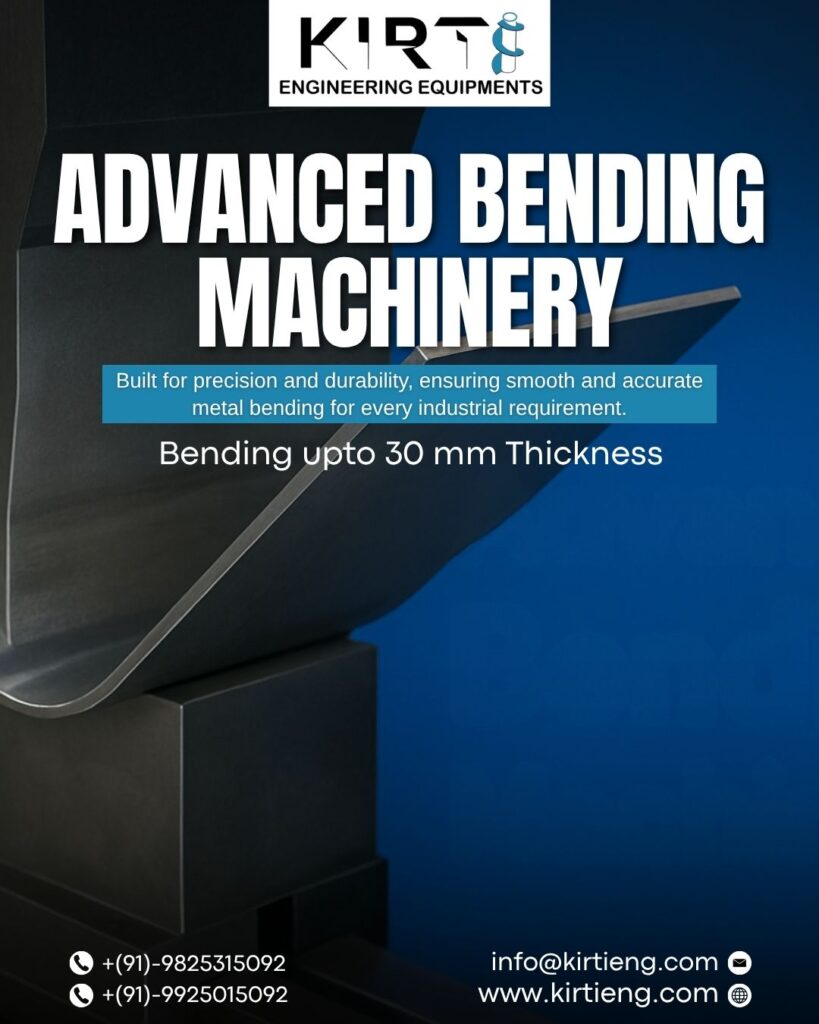
One of the major advantages of advanced bending machinery is its ability to bend metal sheets up to 30 mm thickness. This capability makes it suitable for heavy-duty industrial applications where strength and durability are essential.
Industries requiring thick plate fabrication benefit from:
| Advantage | Benefit |
|---|---|
| Heavy-Duty Bending | Suitable for industrial structures |
| High Strength Components | Improved load-bearing capacity |
| Precision Angles | Consistent fabrication quality |
| Reduced Processing Time | Faster project completion |
Advanced Bending vs Traditional Bending Methods
| Feature | Advanced Bending Machinery | Traditional Bending |
|---|---|---|
| Accuracy | Very High | Moderate |
| Automation | CNC Controlled | Manual |
| Production Speed | Fast | Slower |
| Repeatability | Excellent | Limited |
| Material Waste | Low | Higher |
| Complex Shapes | Easy | Difficult |
| Quality Consistency | High | Variable |
Technical Specifications Table
| Specification | Details |
|---|---|
| Process Type | CNC Metal Bending |
| Maximum Thickness | Up to 30 mm |
| Material Compatibility | Stainless Steel, Mild Steel, Aluminum, Copper, Brass |
| Production Capacity | Prototype to Mass Production |
| Accuracy Level | High Precision |
| Industry Applications | Construction, Automotive, Engineering, Manufacturing |
| Automation | CNC Controlled |
Why Choose Professional Metal Bending Services?
Advanced Technology
Modern CNC bending machinery ensures superior precision and efficiency.
Experienced Team
Skilled operators handle complex fabrication requirements effectively.
Quality Assurance
Strict quality checks maintain dimensional accuracy and consistency.
Custom Manufacturing Solutions
Projects can be tailored according to exact customer specifications.
Fast Turnaround Time
Efficient production processes help meet tight project deadlines.
Reliable Results
Consistent bending quality ensures dependable fabrication outcomes.
Frequently Asked Questions (FAQ)
What is advanced bending machinery?
Advanced bending machinery is CNC-controlled equipment used to bend metal sheets and plates with high precision and consistency.
What thickness can be bent using advanced machinery?
Modern bending machines can handle metal sheets up to 30 mm thickness depending on machine capacity and material type.
Which materials can be bent?
Stainless steel, mild steel, aluminum, copper, brass, carbon steel, and other industrial metals can be bent.
Is CNC bending more accurate than manual bending?
Yes, CNC bending provides superior accuracy, repeatability, and consistency compared to manual methods.
Which industries use metal bending services?
Construction, automotive, engineering, manufacturing, agricultural equipment, and electrical industries commonly use metal bending solutions.
What are the advantages of precision bending?
Precision bending offers improved quality, reduced waste, faster production, and accurate dimensions.
Conclusion
Advanced bending machinery has revolutionized the metal fabrication industry by providing highly accurate, efficient, and reliable bending solutions. With the capability to bend metal sheets up to 30 mm thickness, modern CNC bending systems support a wide range of industrial applications, from construction and engineering to automotive and heavy manufacturing.
Check this :-https://msme.gov.in/
By combining precision, productivity, and versatility, advanced bending machinery helps businesses achieve superior fabrication quality while reducing costs and improving operational efficiency. Choosing professional bending services ensures durable, high-quality components that meet the most demanding industrial requirements.