
Table of Contents
- Introduction
- What is an Industrial Blower Housing?
- Working Principle of Blower Housing
- Key Features of Heavy-Duty Industrial Blower Housing
- Technical Specifications Table
- Benefits of Industrial Blower Housing
- Applications of Industrial Blower Housing
- Industries Using Blower Housing Systems
- Why Choose Kirti Engineering Equipments?
- Maintenance and Safety Tips
- Government Standards & References
- FAQs
- Conclusion
Introduction
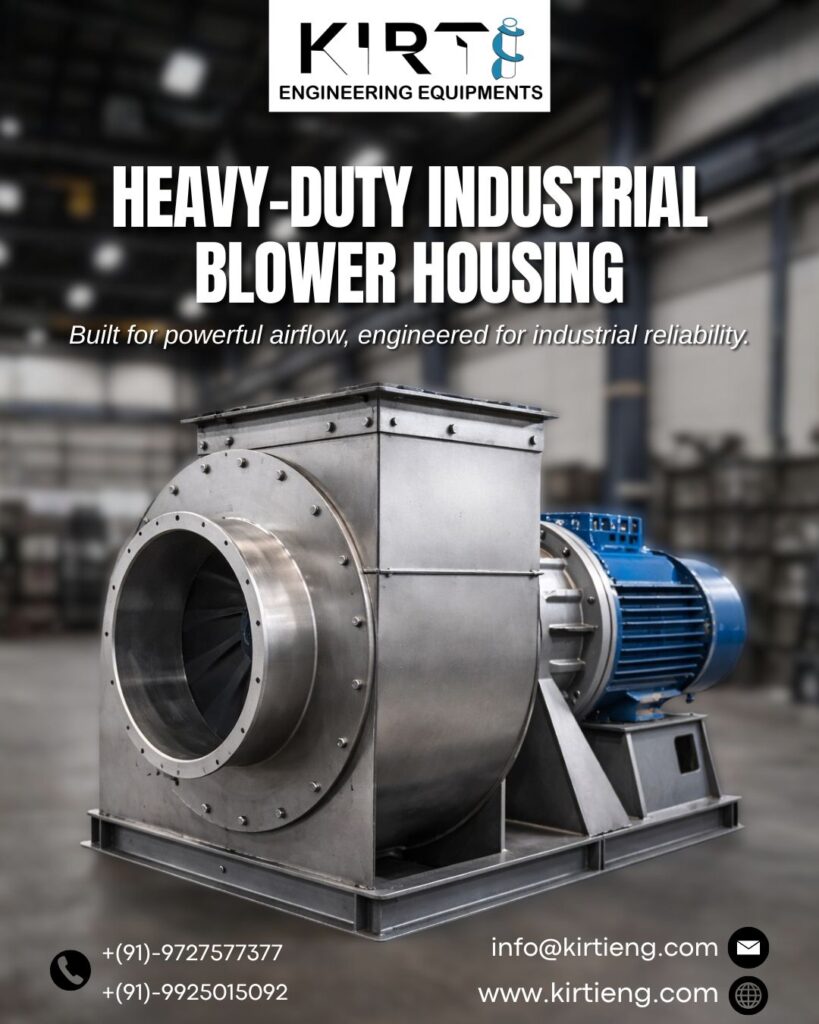
Industrial ventilation and airflow management are critical components of modern manufacturing facilities. A heavy-duty industrial blower housing serves as the protective and structural enclosure for blower systems, ensuring efficient airflow, operational safety, and long-term durability.
Designed for demanding industrial environments, blower housings are engineered to withstand high pressures, continuous operation, and challenging working conditions. Whether used in dust collection systems, HVAC applications, material handling, or industrial exhaust systems, a well-designed blower housing significantly improves airflow efficiency and equipment performance.
Kirti Engineering Equipments manufactures robust industrial blower housings that deliver reliability, strength, and superior airflow performance for various industrial applications.
What is an Industrial Blower Housing?
An industrial blower housing is the outer casing that encloses the blower impeller and airflow path. It is designed to guide air efficiently through the system while protecting internal components from environmental factors and mechanical damage.
The housing plays a vital role in:
- Airflow Direction
- Pressure Management
- Equipment Protection
- Noise Reduction
- Structural Support
- Operational Safety
Industrial blower housings are commonly manufactured using:
- Mild Steel (MS)
- Stainless Steel (SS)
- Galvanized Steel
- Aluminum Alloys
- Heavy-Duty Fabricated Metal
Working Principle of Blower Housing
The blower housing works in conjunction with an impeller and motor assembly.
Step-by-Step Process
| Step | Function |
|---|---|
| Air Intake | Air enters through the inlet opening |
| Impeller Rotation | Motor rotates the impeller |
| Air Acceleration | Air velocity increases |
| Pressure Development | Housing converts velocity into pressure |
| Air Discharge | Air exits through the outlet duct |
| Continuous Circulation | Maintains airflow within the system |
This design ensures smooth airflow with minimal energy loss and maximum operational efficiency.
Key Features of Heavy-Duty Industrial Blower Housing
| Feature | Benefit |
|---|---|
| Heavy-Duty Fabrication | High structural strength |
| Corrosion Resistance | Longer service life |
| Precision Engineering | Better airflow efficiency |
| Low Maintenance Design | Reduced downtime |
| High Pressure Handling | Suitable for demanding operations |
| Durable Construction | Reliable long-term performance |
| Custom Manufacturing Options | Tailored industrial solutions |
| Vibration Resistance | Stable operation |
Technical Specifications Table
| Specification | Details |
|---|---|
| Product Type | Industrial Blower Housing |
| Material Options | MS, SS, GI, Aluminum |
| Design Type | Centrifugal Blower Housing |
| Construction | Heavy-Duty Fabricated Steel |
| Operating Environment | Industrial Applications |
| Corrosion Protection | Available |
| Airflow Capacity | Customizable |
| Pressure Rating | Application Specific |
| Installation | Indoor & Outdoor |
| Maintenance | Low Maintenance |
Benefits of Industrial Blower Housing
Enhanced Airflow Efficiency
Proper housing design improves airflow direction and pressure generation, resulting in higher system performance.
Increased Equipment Protection
The housing protects critical blower components from dust, moisture, and external damage.
Longer Operational Life
Heavy-duty construction ensures durability even under continuous industrial usage.
Reduced Energy Consumption
Optimized airflow pathways help improve energy efficiency.
Improved Workplace Safety
Proper enclosure minimizes exposure to moving components and enhances operator safety.
Cost-Effective Performance
Reduced maintenance requirements and longer service life lower overall operating costs.
Applications of Industrial Blower Housing
Industrial blower housings are widely used in:
- Dust Collection Systems
- Industrial Ventilation
- HVAC Systems
- Air Pollution Control Equipment
- Material Handling Plants
- Cement Plants
- Chemical Processing Facilities
- Food Processing Industries
- Pharmaceutical Manufacturing
- Power Generation Plants
Industries Using Blower Housing Systems
| Industry | Application |
|---|---|
| Manufacturing | Ventilation and cooling |
| Cement | Dust extraction |
| Chemical | Fume handling |
| Power Plants | Air circulation |
| Pharmaceuticals | Clean air systems |
| Food Processing | Ventilation control |
| Steel Industry | Exhaust systems |
| Textile Industry | Air management |
| Mining Industry | Dust collection |
Why Choose Kirti Engineering Equipments?
Kirti Engineering Equipments delivers engineered solutions that meet demanding industrial requirements.
Advantages
Heavy-duty fabrication
Precision manufacturing
Excellent airflow performance
Corrosion-resistant designs
Customized blower housing solutions
Competitive pricing
Reliable after-sales support
Industry-proven quality standards
With a strong commitment to engineering excellence, Kirti Engineering Equipments provides blower housing solutions designed for maximum performance and durability.
Maintenance and Safety Tips
To ensure optimal performance:
- Inspect housing regularly for wear and corrosion.
- Check bolts and fasteners periodically.
- Clean accumulated dust and debris.
- Monitor vibration levels.
- Lubricate moving components as recommended.
- Inspect airflow passages for blockages.
- Conduct routine preventive maintenance.
- Follow manufacturer safety guidelines.
Government Standards & References
For industrial machinery, ventilation systems, and safety compliance, refer to the following official resources:
- Ministry of MSME – https://msme.gov.in
These organizations provide guidelines, standards, and industrial best practices related to manufacturing and engineering equipment.
Frequently Asked Questions (FAQs)
1. What is the purpose of an industrial blower housing?
An industrial blower housing protects the blower assembly while directing airflow efficiently through the system.
2. Which materials are used for blower housing manufacturing?
Common materials include mild steel, stainless steel, galvanized steel, and aluminum.
3. What industries use industrial blower housings?
Manufacturing, cement, pharmaceuticals, chemicals, power plants, mining, and food processing industries commonly use blower housings.
4. Can blower housing be customized?
Yes. Dimensions, material grades, airflow capacity, and mounting configurations can be customized according to project requirements.
5. How does blower housing improve airflow?
The housing guides air through optimized pathways, reducing turbulence and improving pressure generation.
6. Is industrial blower housing suitable for harsh environments?
Yes. Heavy-duty fabricated housings are specifically designed for demanding industrial conditions.
7. How often should blower housing be inspected?
Routine visual inspections should be conducted monthly, while detailed maintenance checks should be scheduled periodically based on operating conditions.
Conclusion
Heavy-duty industrial blower housing is an essential component of modern airflow and ventilation systems. Its role in protecting blower assemblies, directing airflow, improving efficiency, and ensuring operational reliability makes it indispensable across multiple industries. High-quality blower housings help organizations reduce maintenance costs, improve energy efficiency, and maintain safe working environments.
Kirti Engineering Equipments offers precision-engineered industrial blower housing solutions designed for powerful airflow, superior durability, and long-term industrial performance. Whether for ventilation, dust collection, exhaust handling, or process air systems, investing in a reliable blower housing ensures maximum operational efficiency and dependable results.